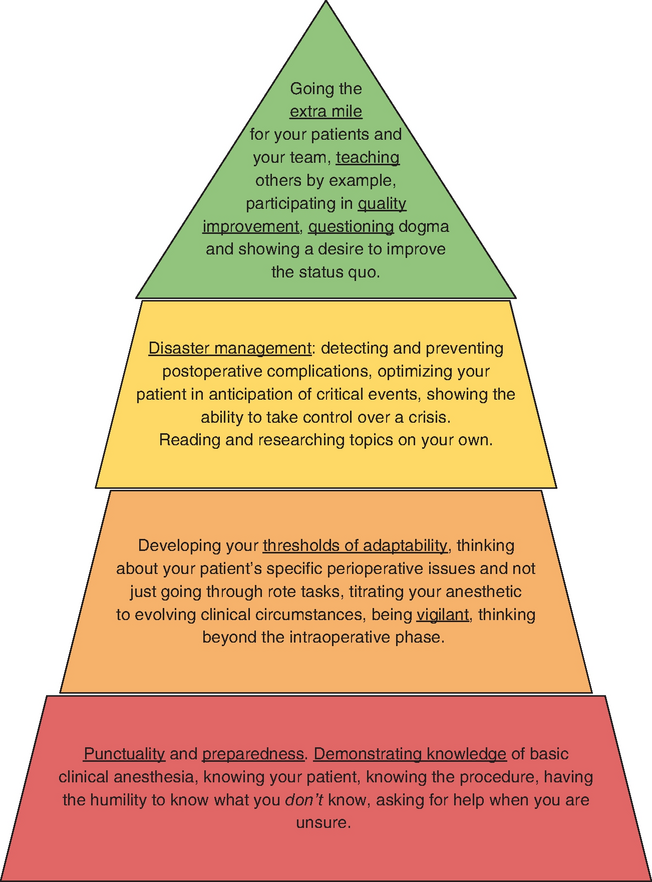
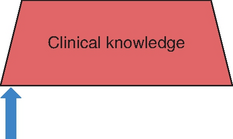
A forward-thinking mindset will set you up for success. See Figure 8.1 for a modified version of Maslow’s Hierarchy of Needs, as applicable to the anesthesia training mindset. The higher you are on the ladder, the more you will get out of training, and the more enthusiastic mentors will be to teach you! Figure 8.1 A modified Maslow’s Hierarchy for anesthesiology trainees. Trainees at the base of the hierarchy are meeting basic expectations. With engagement and curiosity, upward progression is natural and achievable. However, if a trainee is disengaged, inattentive, or unprofessional, the attending’s focus shifts entirely to error prevention—leaving little room for meaningful teaching or growth. I was fortunate to have a mentor who offered tough but honest feedback, which pushed me to improve more than anything else. The value of quality mentorship cannot be overstated, and most programs are willing to provide it if you take the initiative to seek it out. For many, anesthesia training is the first real introduction to “adult learning.” You’ll find that you can’t rely solely on lectures or one-on-one instruction. Independent reading and curiosity-driven questions are essential. Even the most dedicated instructor must balance teaching with supervision and managing pre- and postoperative responsibilities. The reality of our clinical workflow is that a large part of your growth will come from self-directed effort. A trainee who is safe, punctual, and reliable makes teaching deeply rewarding. When those basics are solid, it opens the door to more meaningful discussion and higher-level learning. But when mistakes stem from carelessness or when you show up late, much of my attention has to shift toward keeping things safe and on track. It’s not about punishment, it’s about priorities. The attending’s ultimate goal is not to harm the patient. The more dependable you are, the more space there is for real teaching to happen! In the sample case that follows, you expertly manage a complex renal transplant by anticipating complications, promptly identifying and treating intraoperative anaphylaxis, tailoring monitoring to the patient’s needs, and demonstrating thoughtful integration of clinical protocols with individualized care. You provide the ICU team with insight into the timeline of events that highlights anaphylaxis as your most pressing concern. You suggest a management plan to them that includes continuing the epinephrine drip and re-dosing steroids at a set interval. You read that the suspected offending agent, thymoglobulin, is a rabbit-derived serum, and the patient is allergic to rabbits. You work on a system that pre-identifies patients who may be allergic to this drug to reduce the likelihood of it happening again. You follow along with your patient and present the case as a morbidity and mortality. After administering thymoglobulin, you note a subtle rise in HR and a marked drop in BP, along with hives on the patient’s chest. You proactively treat the BP, open fluid, turn O2 to 100%, and call your attending. You delegate the circulating nurse to bring in the crash cart and prepare an epinephrine drip. You alert the surgeon that you suspect anaphylaxis and will treat it as such. After administration of steroids, antihistamines, and an epinephrine drip, the patient stabilizes. You delegate someone to draw and send tryptase, and call the ICU to arrange for postoperative transport. Throughout this process, you maintain adequate MAPs and anesthetic depth, as well as dose appropriate transplant meds. You read your institution’s policy, which does not universally recommend arterial lines for the procedure, but you consider the patient’s recent stroke and difficult-to-manage hypertension and opt to place one. You consider AV fistula sites and access difficulty issues ahead of time by preparing an ultrasound. You show insight into the complex balancing act between adequate anesthetic depth during periods of stimulation, as well as avoidance of pressors due to concerns for graft perfusion. When surgery asks for a lower SBP, you discuss that you will do your best while still aiming for a MAP of >75 mmHg due to a recent stroke, and you discuss this decision with your attending. You meticulously follow the intraoperative protocol for renal transplant. You plan ahead for IV access challenges, organize your fluid plan, have all transplant meds and diuretics lined up and ready, anticipating when each will be needed. You are “plugged in” to this complex case with all of its moving parts, and know that you will encounter unfamiliar scenarios. You have a low threshold to ask if you don’t understand something. You know the basic milestones, notably that oliguria is an early sign of rejection and would be of great concern to the perioperative team. Anesthesiology residency is designed to be demanding and intellectually challenging, and that is part of what makes it transformative. When you are involved in a complex case, try to see it through rather than handing it off. Staying late occasionally for the sake of your education is not only acceptable, but it is also often where the most meaningful learning happens. Training is your time to seek out challenging or uncommon cases and make the most of them. The experience of managing a big case from start to finish and checking in on the patient afterward teaches invaluable lessons you cannot get any other way. The bar for standing out is lower than you might think! Small, consistent acts of initiative leave a lasting impression and can lead to outsized growth.
Chapter 8
Maslow in the OR: Building a Foundation for Clinical Growth
Related posts:



Stay updated, free articles. Join our Telegram channel

Full access? Get Clinical Tree


