Neurologic terms like ICP and CPP are often used interchangeably in casual clinical use, but they are fundamentally distinct and critically important in perioperative care. An elevated ICP means your patient is much more sensitive to changes in MAP (Figure 31.1). Even small decreases in mean arterial pressure can drastically reduce cerebral perfusion. In extreme cases, it can precipitate ischemia or herniation. Figure 31.1 This cerebral autoregulation curve puts specific numbers to a very complex process that involves metabolic, myogenic, and neurogenic factors. It also applies only to gradual changes in BP and may not be accurate during acute changes. Nonetheless, it is a helpful guide. The brain is capable of autoregulating cerebral blood flow across a wide range of mean arterial pressures (MAP), typically between 60 and 160 mmHg. Below or above this range, the brain becomes increasingly vulnerable to ischemia. These thresholds are rough estimates and, importantly, they shift to the right in patients with chronic hypertension. Given that our standard MAP target in the OR is 65 mmHg, we’re often operating near the lower limit of cerebral autoregulation. In patients at risk for impaired cerebral perfusion, this may not be enough. Practically speaking, a MAP in the 70s or 80s offers a safer margin when you’re concerned about cerebral blood flow. If intracranial pressure (ICP) is elevated, the situation becomes even more precarious. Since CPP = MAP – ICP, any elevation in ICP demands a higher MAP to maintain adequate cerebral perfusion. This means your vigilance should be heightened during moments of hemodynamic vulnerability: induction, intubation, hypovolemia, blood loss, or hypoxia. Even brief drops in MAP or increases in ICP can precipitate catastrophic decreases in CPP, potentially leading to cerebral ischemia or herniation. In a patient with normal intracranial dynamics, transient hypotension may be well tolerated. In a patient with elevated ICP, it may be lethal. There are published case reports and closed claims in which herniation occurred intraoperatively following periods of hypotension after induction, so bear in mind how critical it is to avoid this. This is not the time to be distracted. Even routine tasks like placing an extra IV or adjusting monitors must not draw your attention away from hemodynamic control in a vulnerable brain.
Chapter 31
Neurologic
Understanding Neurologic Parameters
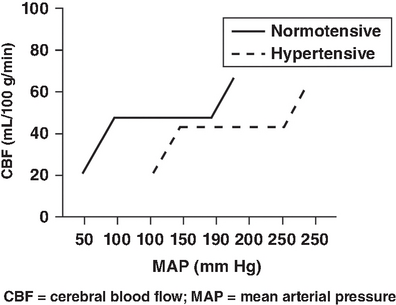
The Cerebral Autoregulation Curve (Lassen’s Curve)
Related posts:



Stay updated, free articles. Join our Telegram channel

Full access? Get Clinical Tree


