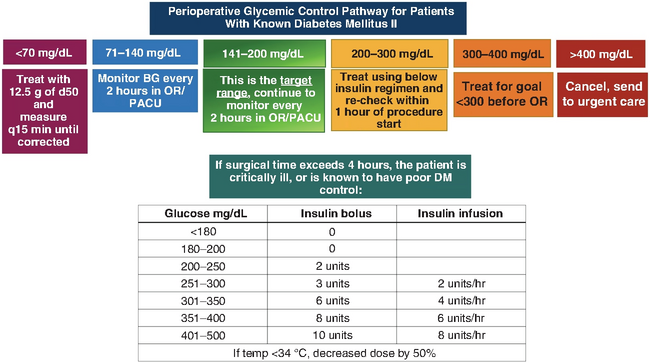
Type I diabetics require continuous insulin, either via long-acting formulations or an infusion. In type I diabetes, it is never appropriate to withhold continuous insulin. Withholding insulin and relying on spot-checking glucose will eventually result in iatrogenic diabetic ketoacidosis (DKA). Both type I and type II diabetics who are insulin dependent are at risk of developing DKA or hyperglycemic hyperosmolar states (HHS) during physiologic stress or prolonged NPO status. This risk is amplified by infection, steroid administration, or myocardial events. Perioperative glycemic management for the patient with type I diabetes will typically involve a discussion with the patient’s endocrinologist since many of these patients are on individualized self-injection treatment and increasingly, automated insulin pumps. Insulin pumps can malfunction if they are near or at the surgical site, if the patient sweats, or if the patient becomes critically ill (poor skin perfusion can impact subcutaneous glucose monitoring), so they may or may not be appropriate to continue perioperatively. An IV insulin infusion is a more secure choice. See Figure 35.1 for a simplified approach to perioperative glycemic management in type II diabetes. Keep in mind that insulin is frequently supplied in highly concentrated vials, making it one of the most high-alert medications in the inpatient setting. Double and triple check prior to administration. A safe and commonly used practice is to dilute insulin into a saline bag (to achieve 1 unit/mL), administer from the bag, and discard the remaining vial to avoid inadvertent use. Insulin adheres to IV tubing, so flush lines thoroughly after administration to ensure full dosing. Figure 35.1 A sample management guide for hyperglycemia in patients with diabetes type II. Classic DKA in type I diabetes involves marked hyperglycemia, resulting in osmotic diuresis, severe dehydration, and lipolysis-driven ketoacidosis. In type II diabetics, some residual insulin activity may suppress lipolysis and ketogenesis, leading to HHS without acidosis. Both forms of hyperglycemia can result in severe volume depletion. Two essential principles of DKA resuscitation are directly relevant in the perioperative setting: The increasing use of SGLT-2 inhibitors (e.g., empagliflozin, dapagliflozin) has added complexity to perioperative glucose management. These drugs improve glycemic control and reduce cardiovascular mortality, possibly via mild ketone elevation and inhibition of the renin–angiotensin–aldosterone system. However, they also introduce the risk of euglycemic DKA (eDKA): a metabolic acidosis with a normal glucose level. In eDKA, urinary glucose wasting puts a check on the usually high levels of hyperglycemia typically seen in DKA. Since glucose can remain normal or only slightly elevated, this tends to delay the diagnosis. eDKA is diagnosed by the presence of blood glucose levels below 200–250 mg/dL (often under 200 mg/dL), a high anion gap metabolic acidosis with arterial pH less than 7.3, serum bicarbonate below 18 mEq/L, and an anion gap greater than 10, along with elevated serum or urine ketones, preferably measured as To reduce risk, most centers recommend holding SGLT-2 inhibitors for 3–4 days preoperatively. If this isn’t done—and especially if the case is not minor—consider checking a basic metabolic panel preoperatively. An elevated anion gap in the absence of hyperglycemia should raise concern for eDKA. Insulin infusions are commonly required in cardiac, transplant, and major vascular surgery. Glucose tends to get very high in settings of extreme physiologic stress, high-dose steroids, and inflammatory response associated with foreign tissue exposure or synthetic materials (e.g., during cardiopulmonary bypass). This is due to the release of catecholamines and cortisol. IV insulin in this setting is not only being used to mitigate hyperglycemia, but to play a protective role against hyperkalemia. This is particularly useful when related to cardioplegia solutions, blood transfusions, or liver dysfunction. You’ll often be asked whether a patient “needs stress-dose steroids.” Always question phrases such as this one! The underlying concern at play is that patients on chronic corticosteroid therapy may have adrenal suppression. Thus, they may be unable to mount an appropriate physiologic stress response to surgery. Despite this concern, most surgeries do not require large surges in steroid output, and most anesthetics are not especially hemodynamically stressful. The risks of unnecessary steroids—including hyperglycemia, infection, delirium, and poor wound healing—should not be overlooked. According to the Endocrine Society Clinical Practice Guideline on Glucocorticoid-induced Adrenal Insufficiency, patients at risk of glucocorticoid-induced adrenal insufficiency include those who have taken the equivalent of ≥5 mg of prednisone daily for more than 3–4 weeks. In high-risk surgeries, these patients may benefit from supplemental hydrocortisone (typically 50–100 mg IV). Decisions should be individualized and discussed with the surgical team.
Chapter 35
Endocrine
Perioperative Glycemic Control and Stress Response
Diabetic Ketoacidosis
SGLT-2 Inhibitors and Euglycemic DKA
 -hydroxybutyrate. Management is the same as for traditional DKA, though the anion gap may close more slowly and reopen due to the long half-life of the drug.
Intraoperative Insulin Use
Stress-dose Steroids: When and Why
Related posts:



Stay updated, free articles. Join our Telegram channel

Full access? Get Clinical Tree


