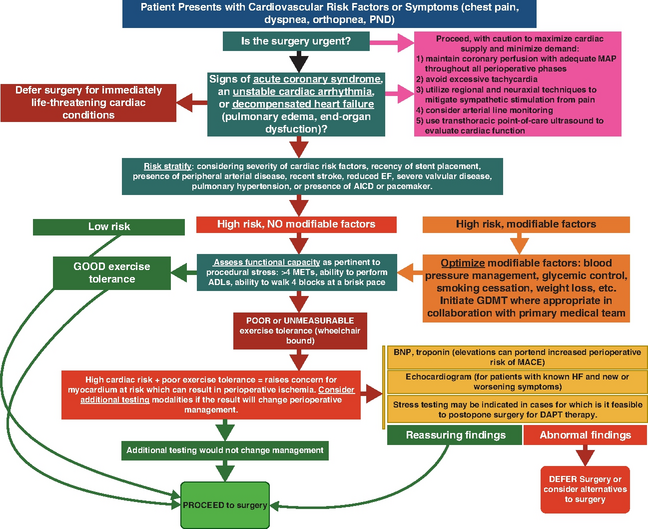
A systematic overview of each organ system and its anesthetic implications is beyond the scope of this book. Since I feel strongly about perioperative medicine, here I present some particularly significant “areas of concern.” The following conditions that I find to be (1) frequently missed, and (2) may significantly alter your anesthetic plan. Many of your patients will come with a long list of cardiovascular risk factors they have collected in their EMR over the years. In the perioperative realm, we care most about the presence of inducible ischemia. While this may seem straightforward, it’s a concept that’s often misunderstood. Some areas of the heart may contract well at rest but become ischemic under stress. The perioperative experience can act as that physiologic stressor in a myriad of ways: hemodynamic alterations, neurohormonal changes, inflammation, pain, shivering, temperature dysregulation, and psychologic stress. This can trigger myocardial ischemia and lead to a cascade of postoperative complications beyond the obvious myocardial infarction: arrhythmias, heart failure, stroke, delirium, and prolonged hospital stays. A sedentary patient may have few, if any, opportunities to stress the heart, so classic symptoms like exertional chest pain may never appear. Fortunately, most anesthetics we administer tend to maintain or reduce cardiac workload. We actively avoid increasing myocardial demand with our techniques, and we also aim to preserve coronary perfusion by preventing severe hypotension, bradycardia, or hypoxemia. Still, we can’t control every variable in the postoperative period. Unforeseen events–airway complications, surgical bleeding, or the systemic inflammatory response—may arise. While typically well tolerated, these stressors can lead to significant morbidity in patients with inducible ischemia. The American Society of Anesthesiologists (ASA) and the American Heart Association (AHA) have collaborated to develop guidelines that streamline the evaluation for inducible ischemia, with the primary goal of avoiding unnecessary and costly preoperative cardiac testing. In reality, very few patients truly require a preoperative stress test. In most cases, it’s neither appropriate nor practical to send a patient for cardiac catheterization or stenting prior to a necessary surgery. The vast majority of procedures we perform are low risk, and modern anesthetic techniques are remarkably safe and minimally stressful to the myocardium. The most recent AHA guidelines (updated in 2024) reflect a set of principles outlined in Figure 11.1. Figure 11.1 GDMT = goal-directed medical therapy, including ACE II, SLGT2, beta blockade when indicated. MACE = major adverse cardiac event. DAPT = dual antiplatelet therapy. Note that cardiology “clearance” is not indicated at any point in the process, nor is it present on AHA guidelines. When considering if results will change perioperative management, consider that management changes can include a variety of: perioperative hemodynamic monitoring, postoperative destination (PACU, admission, etc.), timing of surgery, and left heart catheterization. As you’ll see in the recommended workflow, only a small subset of patients will truly warrant a preoperative stress test. Take, for example, an elderly man with a history of left anterior descending (LAD) stenting a decade ago, who has been largely sedentary due to chronic knee pain and now reports occasional shortness of breath with minimal exertion. This is someone who may be harboring inducible ischemia. If a stress test is positive, the care team might decide to delay his elective joint replacement to allow for further evaluation or possible intervention, such as coronary stenting and a short course of dual-antiplatelet therapy. By contrast, this approach doesn’t apply to time-sensitive surgeries like a Whipple procedure for pancreatic cancer, where the goal is palliative, and delay is not an option. Similarly, it may not apply to an urgent oncologic resection, such as a lobectomy. In these cases, surgery should proceed with appropriate perioperative cardiovascular precautions. A stress test may still be useful to guide intraoperative and postoperative management, but it should inform—not delay—the decision to operate. Despite the existence of these guidelines, which have now been in place in some form for over 30 years, patients are still subjected to a staggering amount of unnecessary cardiac testing. While it’s understandable that a surgical or procedural clinic might generate a scattered collection of studies (an ECG here, an echo there), this fragmented approach should not carry over to anesthesia evaluation. If you believe an echocardiogram is indicated, be prepared to explain why, and more importantly, how it would meaningfully change your management. The answer, according to the guidelines outlined above, is that it likely wouldn’t. In reality, most patients that you see are already as optimized as they’re going to be. Minor medication adjustments rarely justify delaying surgery. Our responsibility, then, is twofold: (1) deliver an anesthetic that carefully avoids aggravating the patient’s underlying conditions, and (2) engage in honest, realistic risk-benefit discussions with patients and the surgical team. There are some conditions for which outside consultants are necessary. Hematology may occasionally be needed for rare bleeding disorders, and obstetrics is, of course, essential for managing nonobstetric surgery in pregnant patients. Neurology might be involved in cases of complex movement disorders requiring specialized medication management. But as a trainee, resist the urge to “offload” cardiovascular conditions onto a cardiologist. Instead, put yourself in their shoes and think through the problem independently. Think of yourself as the patient’s perioperative cardiologist. Most perioperative issues can be understood and managed using a simple concept: reduce myocardial demand, maximize supply. Ethically (and medicolegally, by the way), the patient’s safety is your responsibility, not the consultant’s.
Chapter 11
Preoperative Red Flags
Myocardium-at-risk
Related posts:



Stay updated, free articles. Join our Telegram channel

Full access? Get Clinical Tree


